Me Grimlock King, Even When No Kings
Grimlock has a catchphrase: “Me Grimlock king!” and it gleams like a neon‑chrome paradox in an age suspicious of kings, autocrats, and hierarchical certainties. On one level, it’s pure anachronism: a robotic T. rex asserting monarchical authority in monosyllabic grammar, a cartoon relic from a world where “leadership” could be literal, performative, and entirely unmediated. But on another, deeper level, it resonates as both critique and mirror of our era’s unease with power.
In a society increasingly skeptical of power-grabbing autocrats, Grimlock’s blunt proclamation embodies the raw, unpolished assertion of agency: leadership stripped to its most elemental form, divorced from bureaucracy, legality, or consent. It’s almost comedic in its audacity, yet there’s an existential kernel: the statement reminds us that power, whether in human society or fictional metal worlds, is always rooted in presence, force, and recognition—even if the system around it insists there should be no kings.
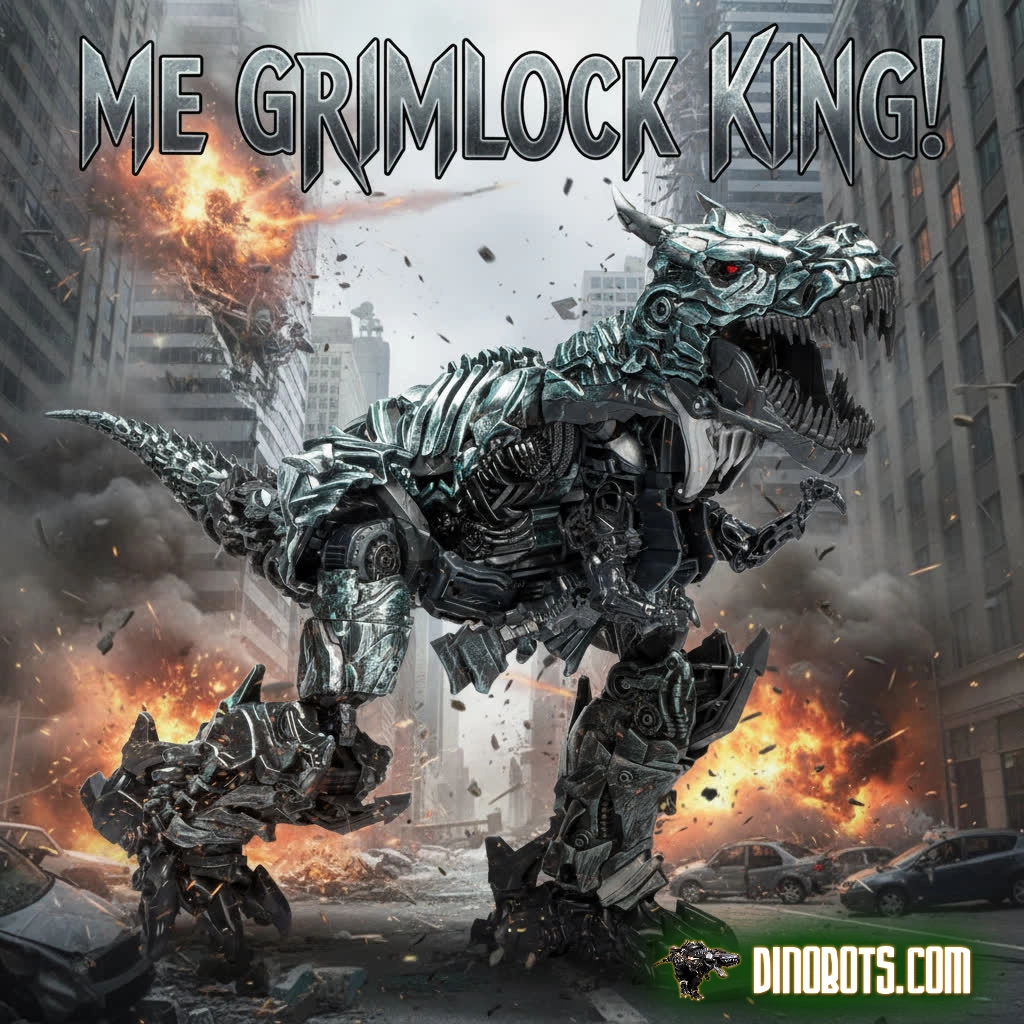
In this sense, “Me Grimlock king!” functions as both rebellion and fantasy. It dramatizes the tension between instinctive authority and socially sanctioned hierarchy: the Autobot council may theorize democracy or consensus, but Grimlock ignores the procedure, leaning instead into what some might call the natural law of the T. rex. In the context of modern discourse, where autocrats are critiqued for exploiting charisma and bureaucrats are questioned for stifling initiative, Grimlock’s roar is anarchic, almost liberatory: it bypasses debate and justification, embracing the absurdity that power itself can exist as spectacle.
Grimlock is, paradoxically, both the anti-king and the king—an entity whose authority is pure performance, raw energy, and existential insistence, offering a gleaming, ridiculous lens through which to examine our own unease with leadership, legitimacy, and the desire for unmediated agency.If you’ve ever watched Transformers and thought, “You know what this show is missing? A T. rex with a bad attitude and a PhD in smashing things,” then congratulations: you’ve found your soulmate in Grimlock. Grimlock isn’t just a Dinobot; he’s the living embodiment of every kid’s dream of stomping everything in sight while speaking in monosyllabic, gravelly syntax. But there’s more to this chrome lizard than meets the eye—or the TV screen. Behind that roar and fire-breathing facade lies a fascinating story of toyline evolution, cross-cultural adaptation, and the weird magic of 1980s American animation.
Putting Me Grimlock King On The Couch
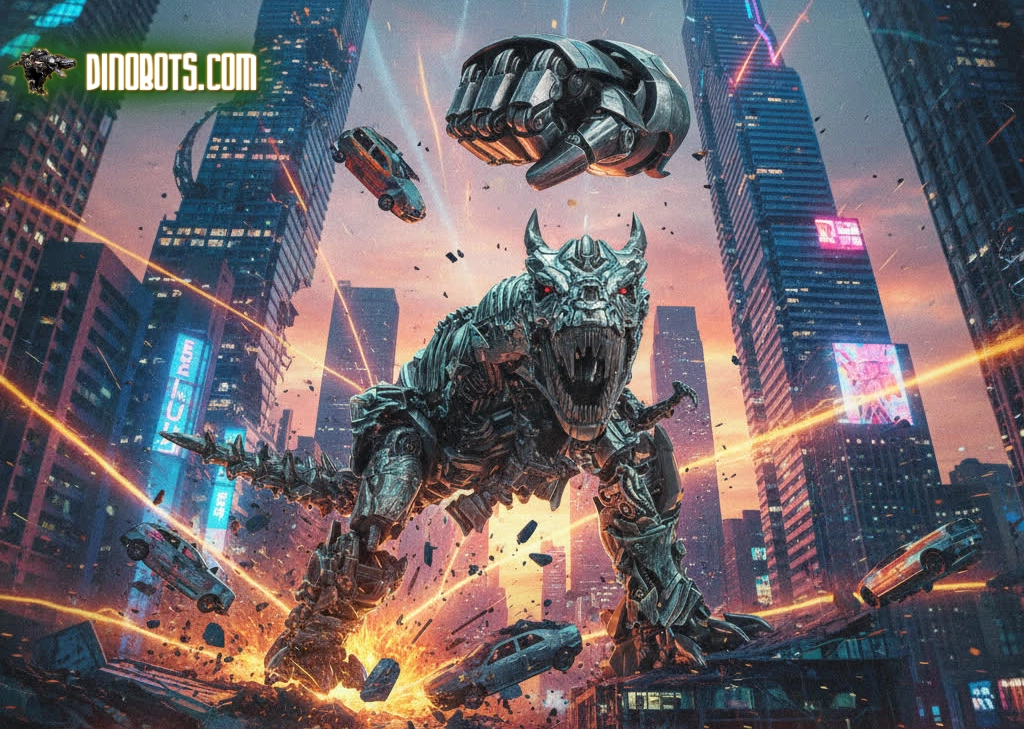
Grimlock is a fascinating paradox of primal id and emergent ego. On the surface, he’s pure impulse: a metallic T. rex who responds first with aggression, then with curiosity, and only occasionally with reflection. His monosyllabic speech—“Me Grimlock king!”—is less a failure of cognition than a defensive compression of complex thought into digestible, action-oriented fragments.
Beneath the brute force, however, lies a deeply conflicted sense of autonomy and authority. In moments where he demonstrates intelligence, inventiveness, or leadership, Grimlock reveals a latent superego struggling to reconcile his desire for self-expression with the demands of group cohesion. His obsession with smashing can be read as both literal and symbolic—a compulsive assertion of control over a chaotic world, a ritualized expression of dominance that masks insecurities about his place among more articulate, socially competent Autobots.
Ultimately, Grimlock embodies the tension between raw instinctual power and the fragile emergence of self-awareness, making him a study in proto-psychological sophistication wrapped in a roaring, fire-breathing metal shell.
Me Grimlock King Roaring Across The Media
Grimlock’s cinematic debut came in The Transformers: The Movie (1986), which is basically an animated fever dream with death, betrayal, and giant robots throwing each other across planets. Grimlock, of course, arrives on the scene in dinosaur mode, fire-breathing and unstoppable, stomping on Decepticons with gleeful violence. One of the film’s most memorable moments is his confrontation with Unicron, the planet-sized transformer-eater: Grimlock doesn’t philosophize; he stomps, bites, and crashes, and it is glorious.
In the TV series, his arcs often combine comedy with sheer physicality. Episodes like “Grimlock’s New Brain” (Season 1, Episodes 10–11) highlight this: after accidentally receiving a scientific “intelligence upgrade,” Grimlock becomes hyper-intelligent, inventing a team of Technobots and almost taking over the universe. Then, in a stroke of classic comic irony, he chooses to revert to his simpler, smashing-oriented self because, frankly, he likes smashing more than thinking.
Grimlock has also seen reinvention in the Bayverse. Transformers: Age of Extinction (2014) brought him to live-action audiences as a colossal, fire-breathing mechanical T. rex. While this version lacks his classic voice or personality, the spectacle is undeniable. He becomes Optimus Prime’s mount in a battle against alien adversaries, showing that even stripped of dialogue, Grimlock’s presence carries narrative weight.
Behind the Scenes: Toy and Animation Magic
Grimlock’s enduring appeal owes much to his toy design. The original Diaclone mold featured robust articulation, removable accessories, and a detailed dinosaur aesthetic that Hasbro preserved and enhanced with metallic paint jobs. For collectors, the differences between the Japanese Diaclone Tyrannosaurus and Hasbro’s Grimlock Dinobot are small but meaningful: cockpit details, color schemes, and the articulation of jaws and tail are all subtly different, giving each toy a unique character.
In animation, Gregg Berger’s vocal performance cannot be overstated. The growl, the gravely monosyllables, the pauses—it’s a voice that conveys both menace and humor. Sunbow Productions used the limited animation style of the era to emphasize Grimlock’s power: slow, deliberate stomps, smashing motions, and exaggerated jaw snaps that made the T. rex feel weighty and alive.